KDE has a new blog series

Germany’s Sovereign Tech Agency has evidently recognised the importance of KDE for open – and therefore sovereign – computing environments. And it has allocated a substantial €1,285,200.00 for the years 2026 and 2027. The new series This Quarter in KDE Digital Sovereignty reflects this and explains what KDE is doing with the funding.
Visible changes that directly benefit the user are not only prominent but can often be implemented quickly. The situation is quite different when it comes to comparatively ‘thankless’ groundwork: it takes up a huge amount of time and, in the end, hardly anyone notices the difference. That is why institutional supporters are so important.
Sovereign Tech Agency
This is where the Sovereign Tech Agency comes in, having raised an extremely generous sum to support KDE: €1,285,200.00 is no small change and is certainly sufficient to resolve the dilemma described above, by ensuring that the poor souls who have to deal with the thankless task of infrastructure work are at least adequately compensated for any hardships they encounter.
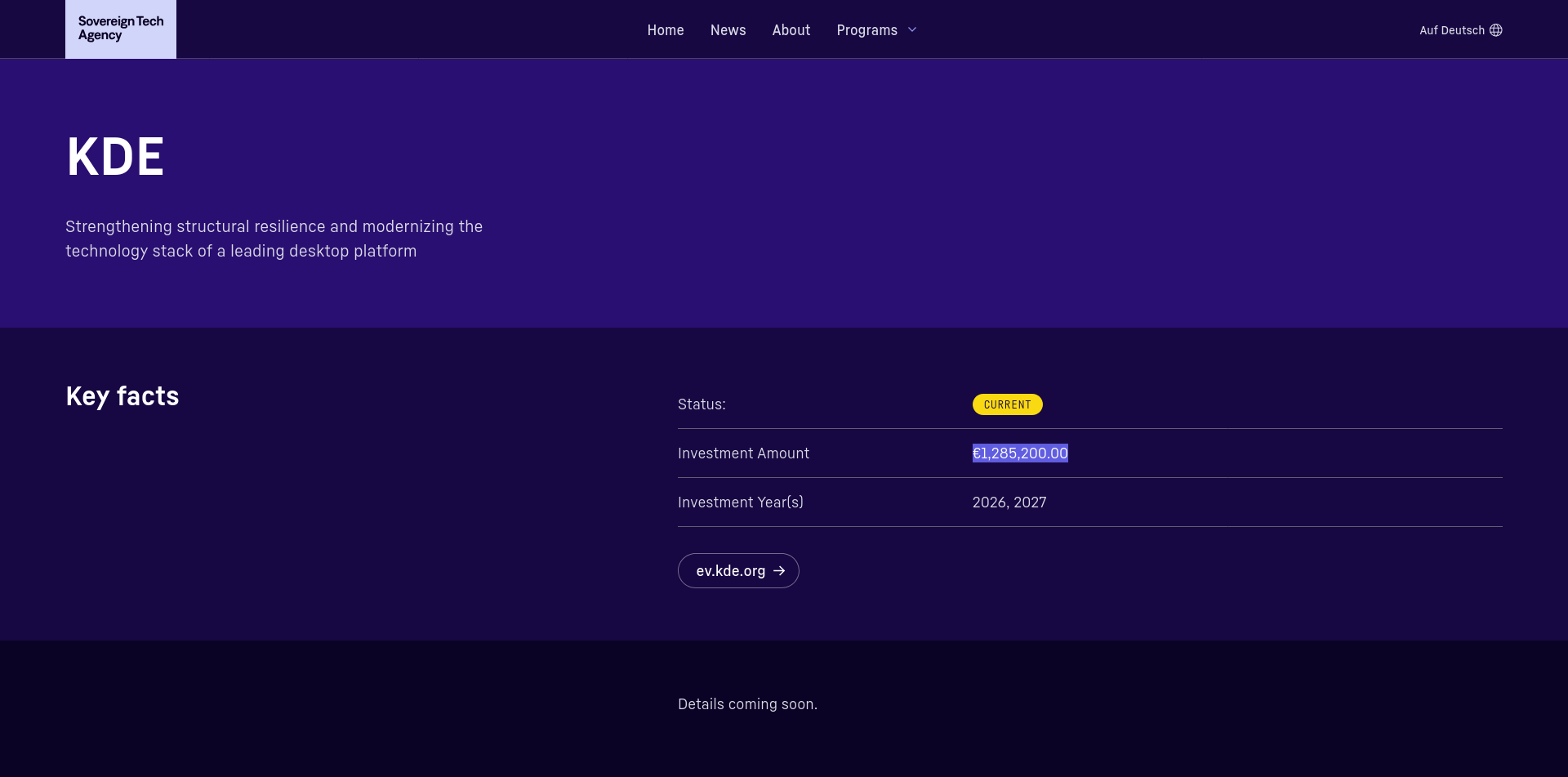
Of course, such an enormous sum requires a thorough accounting, and this is precisely the focus of KDE’s new series, This Quarter in KDE Digital Sovereignty.
Quality assurance
Initially, the focus was naturally on quality assurance, as this forms, so to speak, the ‘foundation’ for all further work: after all, one does not want to have to root out the same bugs time and time again. Furthermore, automated testing acts as a sort of ‘early warning system’ for issues caused by updated dependencies – in the case of KDE, primarily by new versions of the Qt framework used by KDE.
The bulk of the work consisted of getting KDE’s house in order when it comes to automated testing — ensuring things that are working stay working, and providing early warnings about incompatibilities from updated dependencies.
Accordingly, testing suites have been created for KDE PIM and KDE Linux.
Office Sovereignity
In addition, the focus currently appears to be on office-related improvements, namely IMAP4 Revision 2, WebDAV Push Notifications and Handling of network shares. But it is not just office connectivity that is on the agenda.
Accounts, Configuration and Continuous Booting
Accounts will soon be able to be set up simply using an email address and password, just as is already the case with email accounts, for example in Thunderbird’s account wizard. Once this development is complete, users can look forward to an all-in-one setup for email, calendar and identity.
In addition, the project’s own software is currently being ported to utilise the promising KConfigXT system: a declarative approach to describing configuration that is portable and is set to give dotfile managers in KDE a run for their money.
Continuous booting is always handy; after all, black screens aren’t exactly great for productivity 😉. To ensure things still work even after boot-related mishaps, support for Btrfs snapshots, including file versioning, is on the agenda.
Conclusion
A fundamental overhaul of the infrastructure is a time-consuming and costly undertaking, one that, to top it all, does not bring much glory. That’s the bad news.
The good news is that, thanks to the generous support of the Sovereign Tech Agency, this project is now progressing rapidly and – once the ‘renovation phase’ is complete – will pave the way for work that is far more likely to catch the eye of the interested user.


















Comments